This is the first of three articles exploring the remarkable contributions of the sons of an eighteenth century farming family from Allensford that helped frame the world we live in today.
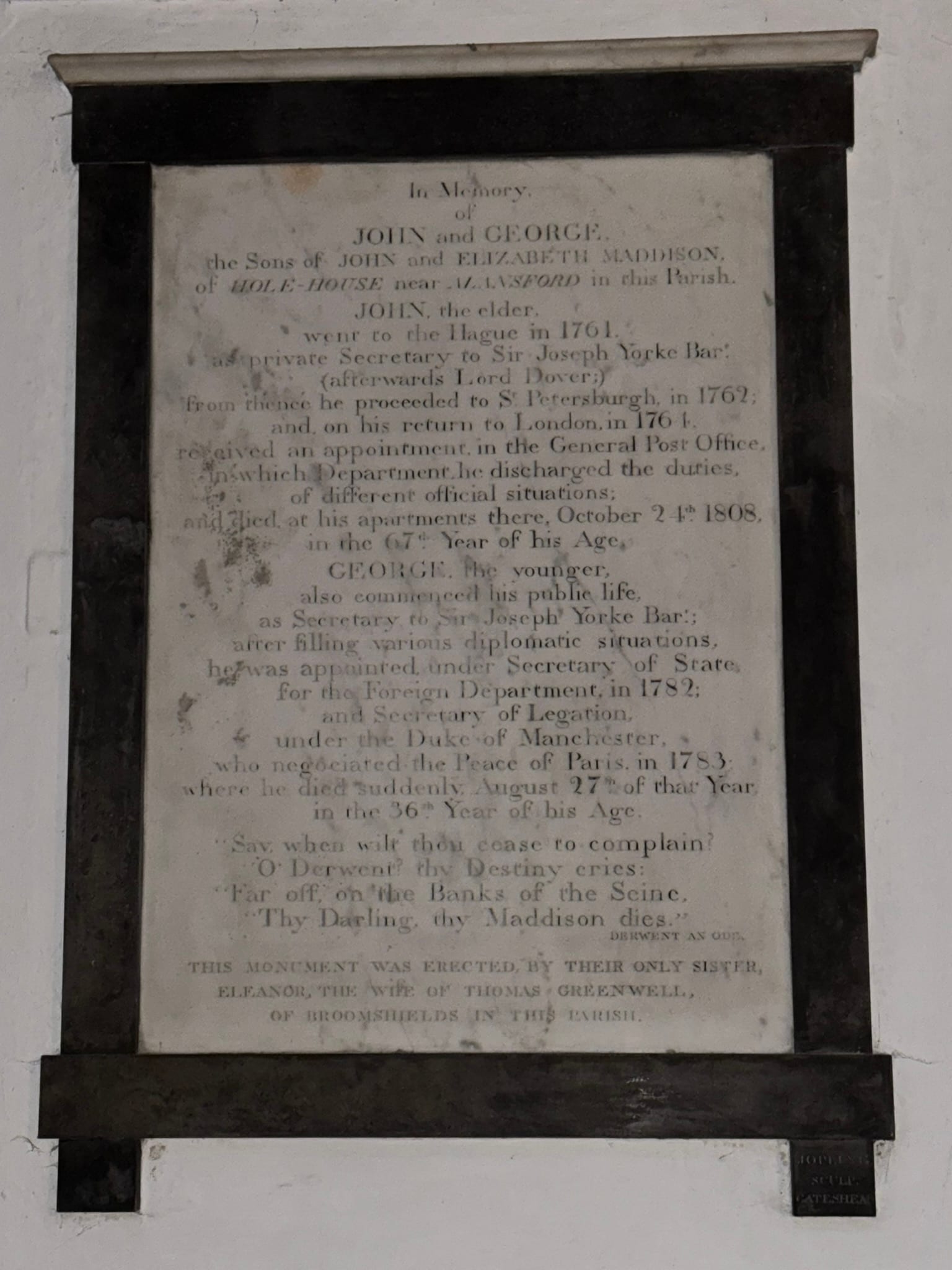
Visitors to All Saints’ Church, Lanchester, may have passed a memorial tablet on the south wall without giving it a second glance. Yet the inscription commemorates two brothers whose lives took them far beyond County Durham into the heart of government and international diplomacy.
It commemorates John Maddison (1741 to 1808) and his younger brother George Maddison (1745 to 1783), sons of John and Elizabeth Maddison of Hole House, Allensford. Though the house itself has long since disappeared, an 1840 map places it near the present site of Allensford Country Park. For more than two centuries it served as the principal seat of the Maddison family. From this remote corner of the Derwent Valley, the brothers rose to occupy offices of national significance and international influence.
A key factor in their success was the influence of their mother’s family. Elizabeth was the sister of Anthony Todd, one of the most powerful figures in the eighteenth century British Post Office. Born at Bridge End, Frosterley, Todd rose to become Secretary of the General Post Office, a position of national importance at a time when the postal system was officially designated a branch of H M Treasury. As their uncle, he sponsored the careers of both John and George.
John Maddison began his career in 1761, aged just nineteen, when he left Allensford to become private secretary to the Ambassador to the Dutch Republic, Sir Joseph Yorke, at The Hague. The following year he accompanied Yorke to St Petersburg before returning to London in 1764 and entering the General Post Office, where he spent more than forty years in a succession of senior posts.
The General Post Office then included the country’s principal intelligence-gathering operation, the Secret Office, hidden within its London headquarters on Lombard Street. Its staff intercepted, steamed open, copied and decoded domestic and foreign mail. Through his time in St Petersburg, John developed expertise in breaking Russian cyphers, and this stood him in good stead throughout his career.

Like his brother, George left Allensford to begin his career under Sir Joseph Yorke, and rose through a succession of diplomatic posts before being appointed secretary to the Duke of Manchester, Britain’s Ambassador to France, in 1783. This proved to be a pivotal year. While 2026 marks the 250th anniversary of the American Declaration of Independence, independence itself was not finally secured until the Peace of Paris seven years later.
Today few people have heard of George Maddison, yet he found himself at the heart of these momentous events. As secretary to the British embassy in Paris, the County Durham native assisted the British delegation during the negotiations that culminated in the treaty. In doing so, he played a part in an agreement that helped shape the modern world.
But as the negotiations approached their successful conclusion, fate dealt a cruel blow. George Maddison died before he could witness the signing of the final treaty to which he had contributed so much.
More next month.
Words and images submitted by Paul Heatherington