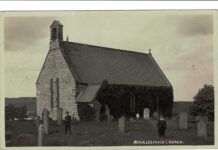
Clive and Caroline Ross are currently in Britain on holiday from their home in Australia. During their visit, they plan to attend St Ebba’s Church on Sunday, 12 April 2026. Caroline Ross is the great-great-granddaughter of the Revd Peter Cameron, whose ministry and death form the subject of the account that follows.
The Revd Peter Cameron completed approved theological studies at the University of Durham, graduating with a Licentiate in Theology (Licentiatus Theologiae). He was ordained deacon on 21 December 1883 and priest on 21 December 1884 by Bishop Joseph Barber Lightfoot. Following ordination, he was licensed to the curacy of Holmside, where he lived with his wife and family at Crieff Villa, Craghead. At the time of the 1891 Census, their sons Duncan George Hedley Cameron, aged six, and William Cameron, aged three, formed part of the Cameron household.
On 24 October 1884, the Consett Guardian reported that Cameron conducted a service at Oxhill, near Stanley where he “preached a very suitable sermon.” By 1885, a Church Mission had been established at Craghead, reflecting the practical difficulty of travelling several miles on foot to Holmside. The mission was jointly served, with the Revd R. Brent, Vicar of Holmside, and the Revd Peter Cameron taking turns to officiate.
In September 1891, Cameron was appointed Rector of St Ebba’s Church, Ebchester, and was inducted on Monday, 19 October 1891. During his incumbency he represented the parish on the Lanchester Board of Guardians and the Rural District Council, and served as Chairman of Ebchester Parish Council. He is credited with being the first to introduce surpliced women, wearing blue college caps, into a mixed church choir. In 1892, he undertook the works to add a vestry and organ chamber to St Ebba’s Church and was “mainly instrumental” in securing the opening of a telegraph office in the village.
The Accident on Ebchester Hill and Its Aftermath
In early September 1895, the Revd Peter Cameron travelled by horse-drawn carriage to visit the Revd Thomas Varley, Vicar of Leadgate. On his return journey, the pony drawing the carriage bolted while descending Ebchester Hill. Cameron was unable to bring the animal under control and, in his efforts to restrain it, over-exerted himself, sustaining severe internal injuries, including a ruptured artery.
The accident left Cameron gravely ill. His personal circumstances made the situation especially pressing. He and his wife Jane Ann Cameron already had three young children, and she was pregnant with their fourth. Aware of the risk to his family’s future and contemplating retirement, Cameron resolved to dispose of the advowson of Ebchester, which he owned and which represented a substantial and saleable asset.
Advowson in the Church of England is the legal right to recommend a clergyman to a vacant benefice. The holder of advowson is called the patron. Advowson developed in earlier times when the lord of the manor would build the parish church and retain the right to appoint its priest. Like freehold land, advowson could be inherited, gifted, or sold. During the Victorian period, the buying and selling of advowsons became increasingly commercialised, giving rise to a class of clerical brokers who advertised livings for sale in the press.
While seriously ill, Peter Cameron entered negotiations through Mr Corbett, a London-based ecclesiastical agent acting for a prospective purchaser. An offer of £2,200 was made, equivalent to approximately £350,000 in modern purchasing power. Cameron accepted the offer by telegram on 30 September 1895 and instructed his solicitor to prepare the contract. As the buyer’s name was not immediately known, it was left blank in the contract pending confirmation. The following day, the solicitor received the necessary details and inserted the buyer’s name. The buyer signed the contract, and his solicitor forwarded it together with the deposit cheque for £220. The transaction was thus concluded. These steps were completed on 1 October 1895, the very day on which Peter Cameron died. He was 39. He died while taking his final practical steps to safeguard the future of his wife and children.
Advowson of St Ebba’s Church Ebchester
Christ’s Hospital in Sherburn, at first a leper hospital, founded around 1181 by Hugh Pudsey, Bishop of Durham was endowed with extensive lands, including Ebchester. In 1863 the Governors of Sherburn Hospital advertise the advowson for sale. Thomas Wilson living at Shotley Hall, Northumberland was the local. In 1836, his family donated both land and funds for the construction of St John’s Church, Shotley Field. In 1850, Wilson gave the land for St Cuthbert’s Church, Shotley Bridge and contributed to its construction costs. Against that background, it was unsurprising that Thomas Wilson bought the advowson for Ebchester’s church and he became the Patron.
The circumstances are now obscured, but it is clear that the Revd Peter Cameron acquired the advowson of Ebchester from Thomas Wilson. A report in the Consett Guardian of 4 October 1895 refers and to his purchase of the living of Ebchester. This is corroborated by Francis Whellan’s History of the County Palatine of Durham (1893), which mentions: “… the living, which is now a rectory in possession of the rector, was formerly in the gift of the master and brethren of Sherburn Hospital. The living is valued at £350, the rector being the Rev. Peter Cameron.”
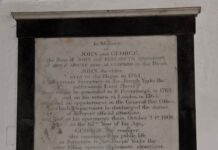
The Consett Guardian of Friday, 11 October 1895, reported on the funeral of the Revd Peter Cameron held at St Ebba’s Church. He was buried in a grave in the church graveyard immediately to the north of the chancel. The image is the frontispiece.
Following her husband’s death, Mrs Jane Ann Cameron proved his will and, acting on assurances given by the purchaser of the advowson that the transaction would be completed, presented the purchaser’s nominee to the living of Ebchester. That nominee was the Revd John George Gibson. The Diocesan Register of Institutions records that Gibson was instituted as Rector of Ebchester on 23 January 1896.
But who bought the advowson?
The name inserted into the contract to buy the advowson of the parish of Ebchester, on 1 October 1895 was Thomas William Christopher Smith (1871–1951). He was the son of Thomas Smith by Margaret Rossiter, who had previously been married to Ralph Gibson. From her first marriage came John George Gibson. Smith and Gibson therefore shared the same mother and were half-brothers. This family relationship later proved highly significant.
House of Lords – 1895
In 1895, the year Peter Cameron died, Frederick Temple, then Archbishop of Canterbury, spoke in the House of Lords on the moral corruption inherent in the buying and selling of advowsons. He described a case in which a purchaser, having secured possession of a living after the incumbent’s death, sought to withhold payment on the pretext that the living had diminished in value. Temple condemned such conduct as dishonourable and questioned whether a system that enabled it should be allowed to continue, warning of its pernicious effect upon the Church. Cameron died on 1 October 1895; Temple’s speech was delivered on 14 May 1895.
Smith did not keep to the agreed terms. Having secured Gibson’s appointment as Rector of Ebchester for 10 per cent of the agreed price, Smith sought to wriggle out of the transaction. Mrs Cameron sued Smith. The hearing was before Mr Justice Byrne in Chancery Court III in London on 27 November 1897. Several newspapers reported the case. The evidence was that Smith had signed the contract but “on all kinds of pretexts” he had prevaricated and refused to complete the transaction. He claimed that he planned to take Holy Orders and meanwhile had put the Revd John George Gibson into the living until “such time as he should be able to enter into possession himself”.
Mrs Cameron won her case outright. Mr Justice Byrne ordered Smith to complete the purchase and pay Mrs Cameron what he had agreed to pay, plus costs. Afterwards, claiming that he was unable to comply with the judgment, the trusting Mrs Cameron agreed a settlement with Smith. The debt was capped at £1900, inclusive of interest and costs. Smith made a payment of £100. Documents were executed, including a mortgage for the balance of £1800, with 4% interest payable from 23 January 1898. Smith promised to pay £1500 by six equal half-yearly instalments, starting in July 1898. The effect of the mortgage was that, until the debt was fully repaid, the right of presentation to Ebchester was Mrs Cameron’s.
From a file of parish correspondence kept within the Office of the Bishop of Durham, the story unfolds as follows. Whilst Smith regularly paid the agreed interest, he paid not one penny of the principal, despite all Mrs Cameron’s attempts to obtain it.
On 31 May 1905, Mrs Cameron married the Revd Basil Morey Ford, sometime Vicar of the Parish of Kirby-Hilton, Diocese of Natal.
Clive and Caroline Ross believe that the Revd Basil Morey Ford and his new wife first arrived in Natal around 1905. Caroline’s grandmother was Jeannie Constance Mary Cameron, born in 1910 at Creighton, Natal, the daughter of William Ambrose Cameron (born 1888) and his wife Ethel Daisy Cameron (née Stewart). The Revd Basil Morey Ford officiated at the Camerons’ wedding, and Jane Ann Ford acted as a witness.
By 1919, the outstanding balance of the payment for the advowson remained unpaid. The Revd John George Gibson, who had guaranteed Thomas William Christopher Smith’s obligations during his incumbency, was by then advancing in age. Acting on his wife’s behalf, Mr Ford wrote to Hensley Henson, then Bishop of Durham, on 5 January 1920, appealing for episcopal assistance to safeguard her financial position.
No reply was forthcoming for more than a year. During this period, Mr J. G. Wilson, the Bishop’s Secretary, advised Henson that the transaction with Smith was “purely business.” On 21 January 1921, Wilson wrote to Mr Ford to convey the Bishop’s view that the matter did not fall within his jurisdiction, adding that Mr and Mrs Ford should be guided by the advice of their solicitor.
Almost 30 years later in 1949, Smith transferred his advowson of St Ebba’s Church Ebchester to the Bishop of Durham and his successors. The London Gazette on 1 February 1949 published the details.
To summarise, in 1895, Smith reached an agreement on Peter Cameron’s deathbed to buy the advowson. The advowson was a significant financial asset of Mrs Cameron in raising four fatherless children (the fourth child, Peter Cameron was born on 30 March 1896). Smith sought to repudiate the agreement he made, but lost the action brought by Mrs Cameron. After losing the case, Smith vacillated for years over payment of the settlement he had agreed. Mrs Camerson had later remarried and became Mrs Ford. In 1948, months before Smith gifted the advowson, Mr and Mrs Ford both died in South Africa – the Revd Basil Morey Ford on the 24th August 1948 and his wife on the 10th September 1948.
Historiographical Assessment
Gibson appears not as an incidental beneficiary of circumstance but as a knowing participant in a transaction marked by bad faith and procedural impropriety. He accepted presentation to a benefice secured through an incomplete and disputed purchase, at a time when the seller was dead and the widow’s sole asset remained unpaid.
In 1974, C. W. Gibby’s John George Gibson (1857–1927), Clerk in Holy Orders: An Exercise in Verification demonstrated that John George Gibson’s public and clerical persona was systematically constructed on misrepresentation. Gibby showed that Gibson repeatedly claimed qualifications, honours, and biographical details that cannot be sustained by primary evidence, and that these claims circulated for decades without effective challenge by either ecclesiastical or scholarly authorities.
Taken together, the evidence supports the conclusion that Gibson was willing to advance his own position under conditions recognisably improper even by the permissive standards of late-Victorian patronage, and that his clerical career was achieved not through merit or vocation but through acquiescence in, and benefit from, conduct fundamentally at odds with fiduciary, pastoral, and ethical responsibility.
Open Questions
Several questions remain unresolved:
Thomas William Christopher Smith was never ordained: did he ever seriously intend to take Holy Orders, or was this merely a convenient justification which he advanced in the course of the court proceedings?
Were the relationships fully disclosed: did Mr Justice Byrne, the Bishop of Durham, or Mrs Ford (formerly Cameron) ever know that Smith was the half-brother of the later-discredited Revd John George Gibson?
Motive in old age: was Mrs Ford’s death the catalyst that prompted Smith, late in life, to attempt the belated act of restitution in donating the right of presentation to the Bishop of Durham?
Later Commemoration
Although the affair formally concluded with the death of Thomas William Christopher Smith in 1951, its legacy resurfaced in the 1970s. During his incumbency as Rector of Ebchester (1970–1979), the Revd Leslie Howe erected a tablet in St Ebba’s Church recording the 1949 transfer of the advowson. Howe had been provided by C. W. Gibby with a copy of John George Gibson (1857–1927), Clerk in Holy Orders: An Exercise in Verification, and was therefore aware that Smith was John George Gibson’s half-brother.
It remains unclear, however, whether Howe was fully aware of the extent to which Gibson’s preferment rested on a transaction whose moral and legal defects were apparent from the outset, or of Smith’s prolonged evasions and manoeuvres in relation to Mrs Cameron (later Ford).
The misrepresentations associated with Gibson did not end with his death. The inscription on his gravestone perpetuates demonstrable falsehoods, recording “Ralph Coxon Gibson” as his father, interred at Aldborough in 1860, and “Margaret Gibson” as his mother at her death in 1913. In fact, his father’s name was plain Ralph Gibson, he was buried at Aldeburgh, Suffolk, not Aldborough in Yorkshire or Norfolk, and his mother— having remarried—was Margaret Smith at the time of her death. The gravestone therefore stands not as a neutral marker of death, but as a final, uncorrected extension of the fictional persona Gibson constructed in life.
These were not incidental errors or clerical slips: the claims had already been shown, by the standards of historical method, to be false. Their survival in stone reflects not ignorance but the enduring power of unchallenged assertion, reinforced by institutional silence and the absence of corrective intervention. Set against this is the near erasure of Peter Cameron, whose gravestone lies neglected and whose name is scarcely visible on the moss-covered memorial in the churchyard.
Gibson’s memorials illustrate how claims to permanence can be secured through self-assertion rather than truth. His gravestone does not merely commemorate; it institutionalises a deception, fixing within the landscape of Ebchester assertions that scholarship has since dismantled. In doing so, it brings to completion the pattern identified by Gibby: misrepresentation asserted, repeated, normalised, and ultimately fossilised— enduring well beyond the point at which the evidential case against it had been decisively made.
Within St Ebba’s Church, the imbalance is unmistakable. Peter Cameron—the rector who acquired the advowson, laboured faithfully in the parish, and died while attempting to secure his family’s future—is remembered only by a minimal entry on a brass plate listing the Rectors of Ebchester on the west wall: “Peter Cameron INST Sept 1891, OB 1895.”
This entry indicates that, having been instituted by the bishop to the benefice in September 1891, Cameron died in office in 1895, OB being the conventional abbreviation of the Latin obiit (“he died”).
The succeeding entry for John George Gibson records “INST 23rd Jan 1896” and “IND 5th March 1896,” marking the institution and induction, and is followed by assertions of his supposed distinctions, including the spurious claim to a Doctor of Divinity (D.D.).
Gibson’s name permeates St Ebba’s Church, both materially and symbolically, appearing:
on the foundation and memorial stones laid during the 1910–11 extensions, including stones bearing the names John G. Gibson, his wife, and T. W. C. Smith;
on hallmarked presentation silver trowels commemorating the laying of those stones, engraved with the church’s image, Gibson’s name, and heraldic devices;
on the communion plate, recording the rededication of the church in 1911 and explicitly naming Gibson as Rector;
in published guidebooks, parish histories, and self-authored works associated with the church, including Our Village of Ebchester;
and in the external fabric of the building, where his name is carved into stone as part of the church’s permanent architectural memory.
The Church of Christ proclaims ideals of Christian equality, humility, and just remembrance. Through scripture, prayer, and inscription, it teaches that all stand equal before God, that earthly status is transient, and that memory should be shaped by faithfulness rather than self-promotion.
Outside St Ebba’s Church, the words “Lest we forget” are prominently carved on the rear of the parish First World War memorial. Beneath that solemn injunction appears the name John George Gibson. The phrase serves as a moral warning against selective or careless memory, and its placement inevitably invites reflection on what—and whom—the church has chosen to remember.
Within St Ebba’s Church, the contrast is stark. Stone and brass confer far greater visibility and permanence on one life than on the other. Cameron—whose ministry ended in hardship and whose memory has largely faded—is almost absent from the church’s internal narrative. Gibson, by contrast—whose preferment has since been shown to rest on misrepresentation and a compromised transaction—is memorialised repeatedly, prominently, and enduringly, accompanied by claims to distinction that are exaggerated or unfounded.
Conclusion: Remembering Well
This account has traced the final years, death, and long aftermath of the Revd Peter Cameron’s ministry, situating his story within the legal practices and ecclesiastical culture of late-Victorian patronage. The documentary evidence reveals a parish priest who invested personally in his cure, lawfully acquired the advowson, and, when faced with sudden illness and death, acted with urgency and care to protect those who depended upon him. His final acts were neither speculative nor self-interested but grounded in responsibility to his family and confidence in assurances that proved, over time, to be grievously misplaced.
What followed was not a single failure, but a succession of delays, evasions, and silences, through which obligation slowly dissolved into endurance. The matter lingered for decades, long after Cameron himself was buried, shaping the lives of others while remaining formally unresolved. Against this persistence of uncertainty, the subsequent advancement and memorialisation of John George Gibson appear all the more striking. His appointment, secured amid incompletion and dispute, developed into a clerical career and a permanent place in the fabric and memory of St Ebba’s Church—despite later demonstration that key elements of his public persona rested on assertion rather than truth.
The contrast is not merely historical, but human. Within the church, stone and brass give voice, permanence, and authority to one story, while another survives only at the margins: in a minimal inscription, a neglected grave, and the private memory of descendants. The church’s teaching speaks of humility, equality, and remembrance shaped by faithfulness; its material record, however unintentionally, tells a more complicated story about power, silence, and the endurance of unexamined claims.
Peter Cameron’s legacy today lies not in prominent monuments, but in the careful recovery of the record and in the living continuity of family memory that has outlasted institutional forgetting. In attending to that recovery, this account seeks neither to unsettle the past nor to apportion blame, but to look more steadily at what was done and what was left undone.
Christian faith holds that truth does not depend on recognition, and that lives are finally weighed not by visibility or advantage, but by faithfulness quietly offered and often unseen. If remembrance is itself a moral act, then how the church remembers — whom it holds in view and whom it allows to fade — matters. To attend carefully to such histories is therefore an act of stewardship: a way of holding truth, mercy, and humility together, so that what endures reflects not assertion, but integrity, justice, and grace.
Paul Heatherington
April 2026
Appendix One
The Revd Peter Cameron and Family
Peter Cameron (1857–1895)
| Event | Date | Place | Notes |
|---|---|---|---|
| Birth | 1857 | Perth, Scotland | |
| Marriage | April 1882 | Durham | Married Jane Ann Parker (1862–1948) |
| Occupation | Before 1891 | Holmside near Lanchester, Co. Durham | Curate of Holmside, c. 7 miles from Ebchester |
| Appointment | 19 Oct 1891 | Ebchester, Co. Durham | Inducted Rector of St Ebba’s, Ebchester |
| Death | 1 Oct 1895 | Durham | Died following accident on Ebchester Hill |
| Probate | 5 Nov 1895 | Durham | Estate £2,138 3s., granted to widow |
Children of Peter Cameron and Jane Ann Parker
| Child | Birth | Place | Death | Notes |
| Duncan George Hedley Cameron | 28 May 1884 | Holmside, Lanchester, Durham | 1968 | Eldest son |
| William Ambrose Cameron | 1888 | Holmside, Durham | — | |
| Evelyne Ebba Mary Cameron | April 1894 | Ebchester, Durham | — | |
| Peter Cameron | 30 March 1896 | Durham, England | — | Posthumous son |
Jane Ann Parker / Cameron / Ford (1862–1948)
| Event | Date | Place | Notes |
| Birth | 1862 | — | |
| 1st Marriage | April 1882 | Durham | To Peter Cameron |
| Widowed | 1 Oct 1895 | Durham | Husband died |
| 2nd Marriage | 31 May 1905 | St Cuthbert’s, Durham | To The Revd Basil Morey Ford (1877–1948) |
| Death of 2nd Husband | 24 Aug 1948 | Maritzburg | The Revd Basil Morey Ford |
| Death | 10 Sept 1948 | Maritzburg | Registered by Ian Edward Armstrong |
Appendix Two
The Rectory, Ebchester
The Revd Peter Cameron and his family resided at The Rectory, Ebchester between 1891 and 1895. The 1881 and 1891 census returns record The Rectory as occupied by the Revd Henry Linthwaite and locate it close to Shaw Lane and Temperance Yard.
The location of The Rectory is shown on the 1895 revision of the Ordnance Survey map of the area, published in 1899 (see map below).
At the time of the 1901 Census, The Rectory, Ebchester was occupied by the Revd William Gilmore Minors, Curate, together with Mrs Esther Jackson, his housekeeper and Westwood House is well documented as the residence of Cameron’s successor, the Revd John George Gibson. Ebchester.
By Paul Heatherington

Become a Contributor at Consett Magazine