In last month's article, I introduced George Maddison of Hole House, Allensford, who found himself at the centre of one of the most important diplomatic events of the eighteenth century. As Secretary of Legation to the Duke of Manchester, Britain's ambassador to France, he played a significant role in the negotiations that led to the Peace of Paris. The treaty formally ended the American War of Independence and helped define the boundaries between the newly independent United States and British North America. Yet George Maddison never lived to see the agreement signed.
On 27 August 1783, only days before the treaty's conclusion, George died suddenly in Paris at the age of just thirty-six. Contemporary accounts suggest that his death was sufficiently unexpected to warrant a post-mortem examination. Rumours circulated that he may have been the unintended victim of poisoning, the intended target being the Duke of Manchester himself. His sudden death was significant enough to be mentioned in correspondence between his uncle, Anthony Todd, and Benjamin Franklin, the American statesman, scientist and diplomat.
George was accorded a formal funeral attended by diplomats and other dignitaries. A solemn procession accompanied his coffin to what contemporary reports described as the "Swedish burying ground", a cemetery used for Protestant foreign nationals who died in Paris. It was a long way from the Derwent Valley where he had been born and raised.
News travelled slowly in the eighteenth century, but eventually word reached Hole House near Allensford, the ancestral home of the Maddison family. There, his relatives could scarcely have imagined that one of their own would die in the French capital while helping negotiate a treaty that reshaped the political future of the Atlantic world.
Breaker of Russian cyphers
George's elder brother John Maddison survived him by twenty-five years and enjoyed an equally distinguished career. After leaving Allensford, he entered the diplomatic service, serving under Sir Joseph Yorke at The Hague before travelling to St Petersburg, where he was sent at the express command of King George III to learn Russian. Returning to London in 1764, he joined the General Post Office and remained there for more than forty years. Much of his service was spent in the Secret Office, the department responsible for gathering intelligence from intercepted correspondence. In 1787 he succeeded his uncle, Anthony Todd, as Foreign Secretary to the General Post Office.
John's remarkable career attracted the attention of modern scholars. More than two centuries later, in 1987, Professor Anthony Cross devoted an article to him entitled John Maddison: Breaker of Russian Cyphers and Collector of Russian Books. The title captures both his professional achievements and his intellectual interests. Cross describes his expertise in intercepting and deciphering Russian communications, skills that made him a valuable servant of the British state during a period of intense international rivalry.
A library of 5,244 volumes
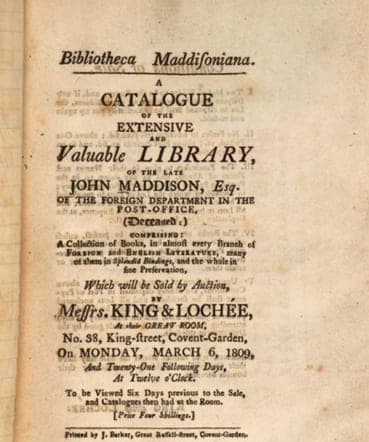
John was also an avid book collector. Following his death in 1808, an auction catalogue entitled Bibliotheca Maddisonia revealed the scale of his library. Containing no fewer than 5,244 volumes, the collection was remarkable both for its size and its range. The catalogue itself extended to 220 pages and listed 146 Russian works, a substantial number for the period. So extensive was the collection that the auction lasted twenty-two days.
Neither George nor John married, and neither left descendants. Nor did either brother return to County Durham in death. George was buried in Paris, while John was laid to rest in the crypt of St Mary Woolnoth, the celebrated City church beside the Bank of England in the heart of London. There he remained for more than eighty years until 1892, when the crypt was partially cleared during the construction of Bank Underground Station beneath the church. In yet another unexpected twist to the family's story, John's remains were among those removed.
Remembered in Lanchester
Although neither brother rests in his native county, both are commemorated in All Saints' Church, Lanchester, by a memorial erected by their sister Eleanor. In 1774 she married Thomas Greenwell of Broomshields, linking the Maddisons with one of the district's most prominent landed families. Following the deaths of John and George without heirs, Hole House eventually passed into Greenwell ownership, although members of the Maddison family continued to farm the estate for another fifty years.
The Maddison memorial on the south side of the nave is complemented by another on the north side dedicated to Eleanor's Greenwell descendants. Together they stand as reminders of two interconnected County Durham families whose influence extended far beyond the Derwent Valley.
The tablet records only the bare facts of the lives of John and George Maddison, but beneath the inscription appears a poignant extract from Dr John Carr's Derwent: An Ode:
Say, when will thou stop to complain?
O Derwent! thy destiny cries;
Far off, on the banks of the Seine
Thy darling, thy Maddison dies.
Behind those few lines lies an extraordinary story. It stretches from a country house at Allensford to the corridors of power in London, the diplomatic salons of Paris, and the imperial court of St Petersburg. It is a story of ambition, service and learning; of international diplomacy and secret intelligence; and of two Durham brothers whose lives reached far beyond the valley in which they were born. The memorial in Lanchester Church may be modest, but it commemorates men whose careers connected a small corner of County Durham to events of global significance.
More next month.
Read part one: consettmagazine.com/maddison-brothers-allensford-peace-of-paris-part-one
By Paul Heatherington