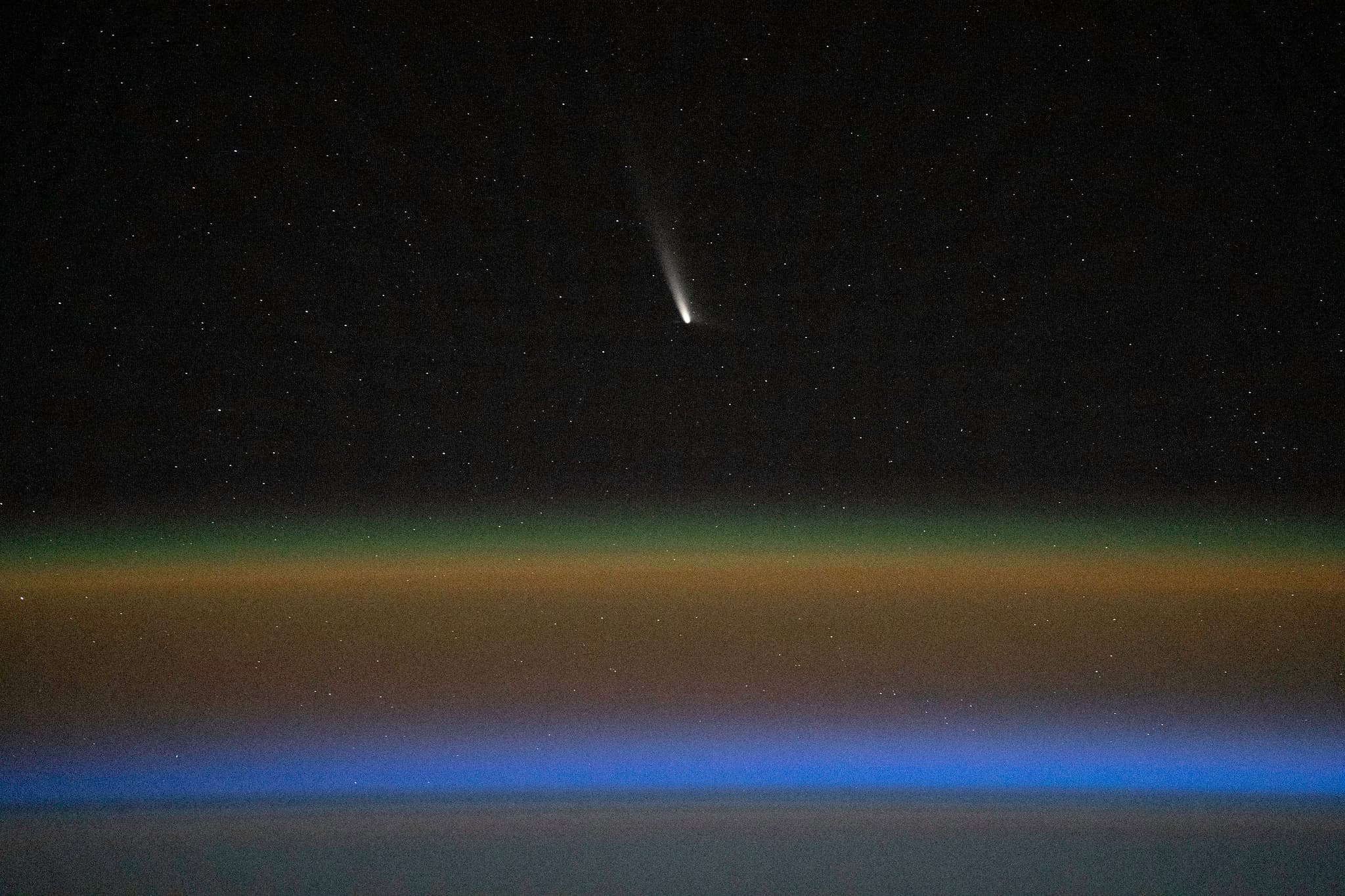
This October, the night sky over Consett is hosting a spectacular celestial event: Comet C/2023 A3 (Tsuchinshan-ATLAS), also known as the “comet of the century.” This rare comet, last seen 80,000 years ago during the time of the Neanderthals, is now visible to stargazers across the Northern Hemisphere, including here in Consett.
Comet A3, discovered in early 2023 by the Tsuchinshan Observatory in China and the ATLAS programme in South Africa, has made its journey from the Oort Cloud—a distant region of icy objects at the edge of our solar system. What makes this comet so fascinating is its bright green glow, caused by diatomic carbon reacting to sunlight, and its long, dramatic tail, which is expected to grow up to 40 times the size of the full Moon.
Otrzymujemy od Was fantastyczne zdjęcia komety C/2023 A3 (Tsuchinshan-ATLAS), która widoczna była na #krakow.skim niebie. Kamil Pękala uchwycił ją z kopca Piłsudskiego, a Wojciech Nowak z Nowej Huty. #kometa @MeteoprognozaPL pic.twitter.com/yxbBvPjL1S
— Kraków (@krakow_pl) October 14, 2024
Best Time and Place to Spot Comet A3 from Consett
For residents hoping to catch a glimpse of the Consett comet visible in the night sky, now is the time to look west just after sunset. From 15–31 October, Comet A3 will be travelling across the constellations Serpens Caput and Ophiuchus. The comet will remain visible until 30 October, so there are plenty of opportunities for skywatchers to observe this rare event.
To get the clearest view of the Consett comet visible, head to higher ground with an unobstructed view of the horizon. Derwent Reservoir is a perfect location, offering open skies away from the distractions of city lights. Be sure to wrap up warm as the October evenings can be chilly, and bring a pair of binoculars for a better view of the comet’s glowing tail.
The Science Behind Comet A3
Comet A3’s journey from the Oort Cloud brings it into the inner solar system, where it is currently passing about 44 million miles from Earth. The Oort Cloud is a vast region of space made up of billions of icy objects, believed to be remnants from the formation of the solar system. Comets like A3 occasionally get pulled inward due to gravitational forces, allowing us to witness these ancient space travellers.
The comet’s green colour comes from its chemical composition. Diatomic carbon (C2) in the comet’s head reacts to sunlight, giving off a bright green glow that makes it stand out in the night sky. As Comet A3 moves closer to the sun, the heat causes gases and dust to evaporate from its surface, creating a long, glowing tail.
#CometATLAS on the western horizon tonight, looking towards the Dingle Peninsula.
— Leona Kane (@Leonaa_x) October 14, 2024
Last seen 80,000 years ago and not to be seen again for another 80,000. Honestly, some things are just mind-blowing.
Surreal to be witnessing a once in a lifetime event 💭✨☄️ pic.twitter.com/tfiUAHrdNW
How to Capture the Consett Comet Visible on Camera
Photographers and astronomy enthusiasts in Consett can try to capture the Consett comet visible using a DSLR camera or even a smartphone paired with a telescope. Dr. Robert Massey of the Royal Astronomical Society recommends holding a phone up to the eyepiece of a telescope to capture the comet in detail. With its vibrant colour and growing tail, Comet A3 should make for stunning photos, similar to previous comets like NEOWISE.
Don’t Miss This Celestial Event!
With its 80,000-year orbit, Comet A3 won’t be visible again in our lifetimes, so this is a rare opportunity for the Consett community. Be sure to take time to look up and enjoy this cosmic wonder while it’s still visible. Head to Derwent Reservoir in the coming days and marvel at this spectacular display before the comet makes its way back into the depths of space.
Comet Tsuchinshan-Atlas seen over Mt. Adams a few hours ago! 🤯☄️ pic.twitter.com/rEWua6NKa9
— KRL (@KennethLerose) October 14, 2024
For more cosmic events over Consett, take a trip back to 2013, when Chris Brown reported on another stunning comet sighting. Read the full story here.
And in 2012, I witnessed a breathtaking meteor fireball light up the skies over Consett, a rare event we covered here.